bluegrass guitar lesson

Why Your Solo Flatpicking Sounds Empty (And How to Fix It)

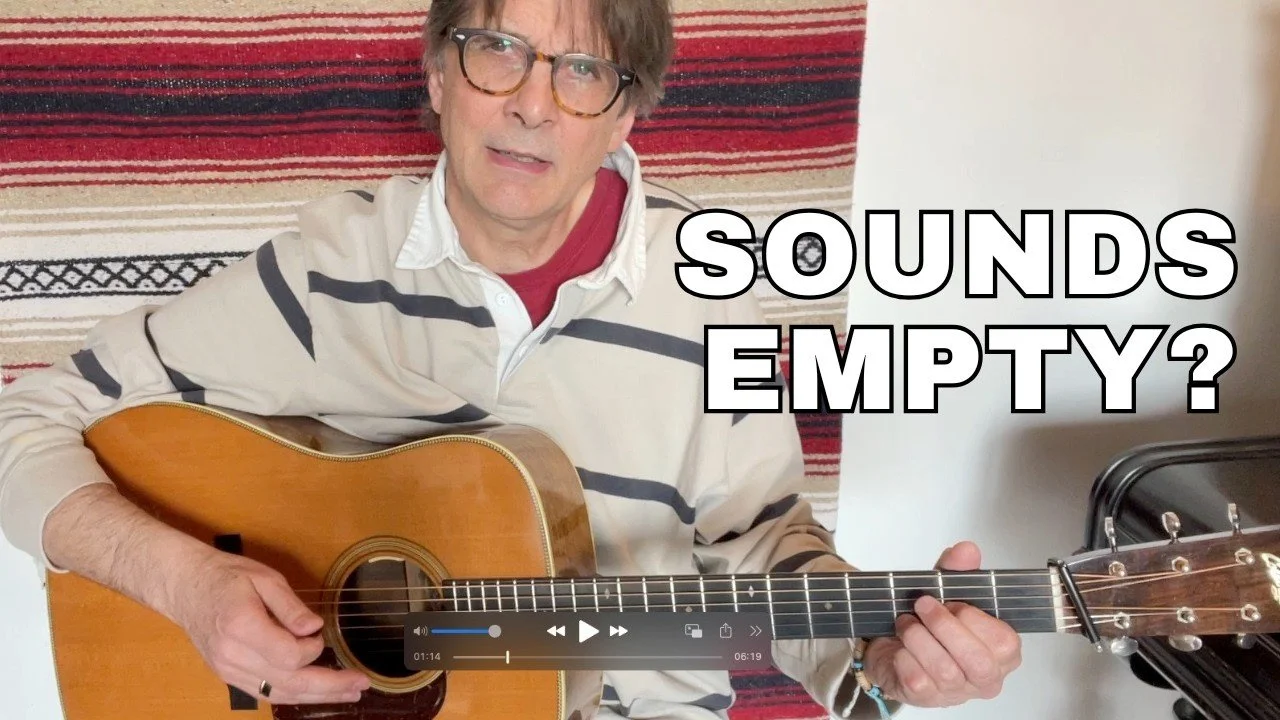
Why does solo flatpicking often sound empty?

Many flatpickers grow up playing lead over a rhythm guitar. The melody is clear, the notes are clean — but when you sit down alone with your instrument, something feels missing.

The problem is not speed. It’s not a lack of licks.

It’s harmony.

Watch the full lesson here:


The Real Reason It Sounds Empty

When you play only the melody, there is space between the notes.

Without bass movement or harmonic definition, the listener doesn’t clearly hear what chord you are playing over. The line may be correct, but it feels incomplete.

That’s why solo flatpicking can sound thin or empty even when you’re playing the right notes.

How to Fix It

A ringing bass note — or even a single open string — can completely change the sound.

It can:

– fill the space between melody notes
– outline the chord
– define the harmony
– keep the rhythm moving

You don’t always need a full boom-chuck pattern.

Sometimes one steady note underneath the melody is enough to make the guitar sound much more complete.

You Are the Band

When you play solo flatpicking, you are not just the lead player. You are the rhythm section and the melody at the same time. That requires steady time and clear harmonic thinking.

If the rhythm underneath is unstable, the melody won’t feel grounded. That’s why solid fundamentals matter more than speed or flashy licks.


In the full video lesson, I demonstrate exactly how this works in practice:
https://youtu.be/9j19AUgAgug


Work on one tune you already know. Add a steady bass note underneath.
Listen to how the sound changes.

Small adjustment. Big difference.

Doc Watson–Style Descending D Lick – Double Stops That Resolve to G

If you love Doc Watson’s clean, melodic, and soulful flatpicking, this lick is for you.

In this lesson, I share a descending dominant D lick inspired by Doc’s unmistakable style — full of double stops and chromatic movement that create beautiful tension before resolving to G.

It’s a short phrase you’ll hear often in bluegrass and fiddle tunes, but the way Doc played it made it sound timeless: simple on paper, yet rich and expressive in tone.

🎸 Why This Lick Works

  • It’s based on the D7 sound, the perfect dominant chord before resolving to G.

  • The chromatic descent gives it a strong sense of movement and anticipation.

  • The double stops make the line sound full, giving that signature “two-guitar” sound Doc often achieved with just one flatpick.

You can use this lick anytime you move from D to G — in endings, transitions, or even as part of your improvisation. It’s a classic sound every flatpicker should have under their fingers.

🎥 Watch the Lesson

I break it down note by note in my new YouTube video:
👉 https://youtu.be/J4GaXg11sq8

You’ll see exactly how the lick works, how to phrase it smoothly, and how to make it sound musical at any tempo.

If you’d like to explore more Doc Watson–style ideas, I’ve got hundreds of lessons, tabs, and play-alongs available inside my channel or at my online store.

How to End a Song in the Key of C — Stylishly (and With a Smile)

Ten months ago, my left-hand index finger and I went through a little adventure: surgery for Dupuytren’s contracture. Since then, we’ve been in daily “recovery training” — thirty minutes of stretching and strengthening every single day.

Progress? Slow. Very slow. So slow that a second surgery might be in my future. But I’m not giving up. For guitar players, our hands are our treasure. Getting older might bring its share of interesting surprises, but we keep going, adapt, and try not to lose our smile (or our sense of humor).

If you’re new here, you might also enjoy my Flatpicking Guitar 101 Crash Course — it’s a free beginner-friendly guide to get you started with solid picking technique.

Why Endings Matter in Guitar Playing

While I’ve been working my way back to full strength, I’ve been reminded of something important: a great ending can turn a good song into a memorable performance.

That’s why I just uploaded a new flatpicking guitar lesson on YouTube: how to end your songs in the key of C with style.

A Closing Lick from Low C to High C

In this lesson, I teach a beautiful closing lick in C that starts on the low C note and climbs all the way up to the high C on the first string, 8th fret. It’s a quick journey, but packed with expression.

We’ll go through the lick note-by-note so you can play it cleanly and musically. I also cover two essential techniques that make this lick stand out:

  • Dynamics — controlling volume for expression

  • Ritardando — slowing down naturally to signal “this is the end”

These tools aren’t just for this lick — they’ll improve your overall guitar phrasing and give your endings more character.

Watch the Free Flatpicking Guitar Lesson

You can watch the full lesson here: https://youtu.be/gYwDPf4JU9I

Whether you’re a beginner learning your first C chord or an experienced flatpicking guitarist looking to polish your arrangements, this lick is a great way to give your songs a professional, satisfying ending.

Music and Life: Both Are a Climb

In a way, this lick feels a little like my recovery — starting low, moving step by step, and enjoying the journey to the top. Whether you’re climbing the fretboard or climbing out of a challenge, every step counts.

So pick up your guitar, try this lick, and see how it changes the way you finish your songs. And if you’d like to learn more bluegrass flatpicking licks, you can explore my Flatpicking Experience channel, where I share exclusive licks, arrangements, and techniques.

Happy picking,
Roberto